Financial literacy.
From first paycheck to first investment.
Twelve units take you from your first budget to your first investment: banking, interest, credit scores, credit cards, loans, paychecks and taxes, stocks and index funds, 401(k)s and IRAs, real estate, crypto, and scams. Every unit has a free calculator or simulator, practice problems with answers, and an assignment.
Sources are open textbooks, peer-reviewed journals, and .gov and .edu sites, listed at the end of every unit.
Who it's for.
One course for high school students and adults. Everyone works through the same lessons.
High school, grades 10 to 12
A full semester of personal finance for homeschool families and co-ops, with practice, Tool Labs, and a final plan.
Adults
Anyone who wants to get out of debt, start investing, or finally understand a 401(k), a mortgage, or a credit score.
Free tools
Budget, savings, compound interest, card payoff, loans, paycheck taxes, a demo portfolio, and more. Nothing you type is saved or sent.
Start here: the Wealth Flywheel.
One picture that every unit comes back to. Read this before Unit 1, about 20 minutes.
Read Start Here
It is 6:40 on a Saturday morning. Jordan, 17, is sorting tips from a weekend job on the kitchen table: $86 in crumpled fives and ones. (Jordan is a made-up student, but you may know someone just like Jordan.) Jordan has two questions. Is this ever going to add up to anything? And what do the people who seem to get ahead know that I don't?
This course answers both questions. But the first answer is not a stock tip or a secret account. It is a picture.
Meet the Flywheel
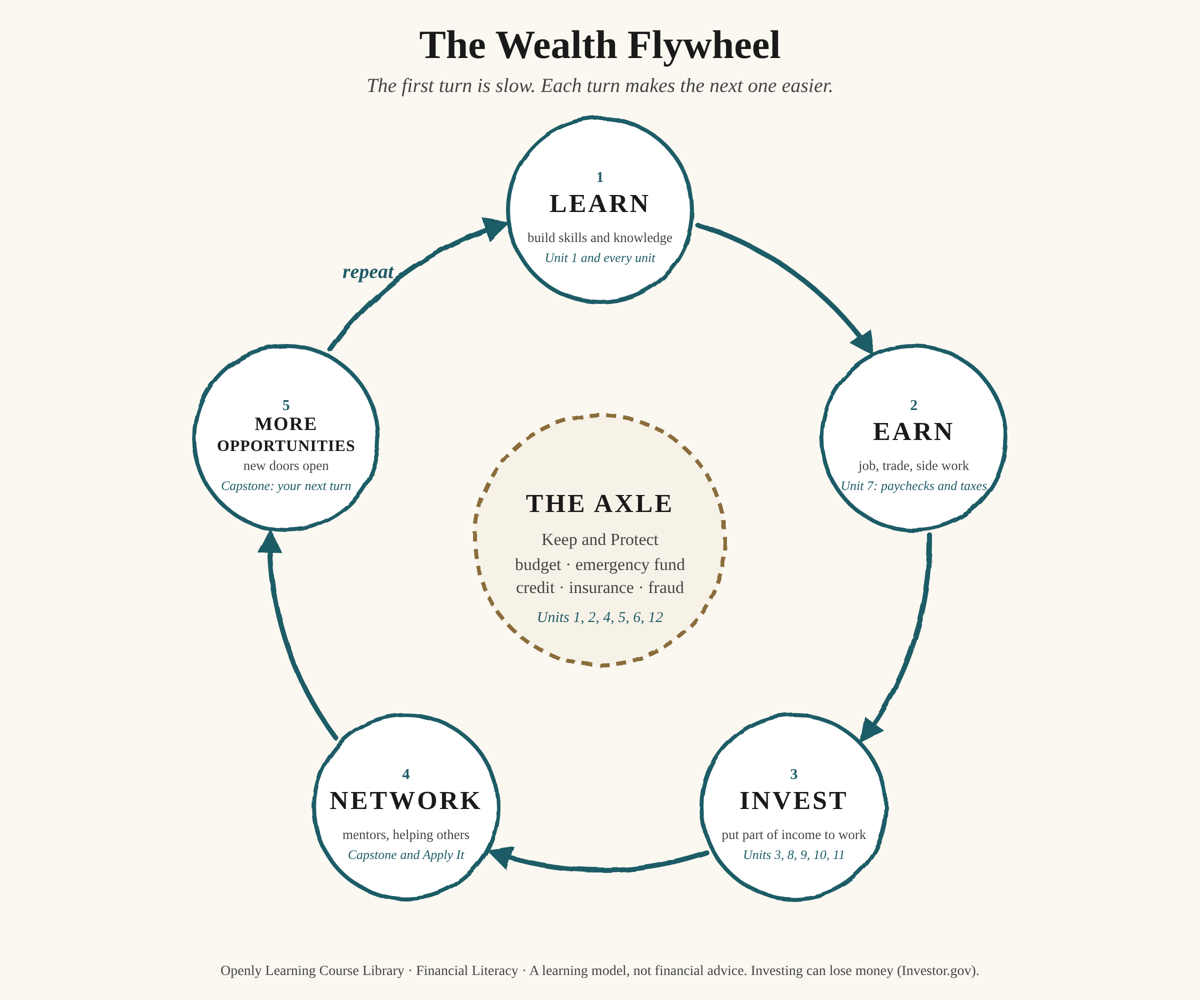
A flywheel is a heavy wheel used in engines and machines. It is hard to get moving. The first push barely turns it. But each push adds to the speed it already has, so every turn is a little easier than the last one, until the wheel almost seems to turn itself.
Money and skills often work the same way. This course uses a simple model we call the Wealth Flywheel. It has five stops and one axle:
- Learn. Build skills and knowledge, in school, in a trade, on the job, or in a course like this one.
- Earn. Use those skills to earn income from a job, a trade, side work, or a small business.
- Invest. Put part of every paycheck to work in safe savings first, then in long-term investments that can grow.
- Network. Build relationships: mentors who teach you, and people you help.
- More Opportunities. New skills, savings, and people open new doors. Then the wheel turns again.
The axle: Keep and Protect. A wheel is only as good as the axle it spins on. If money leaks out through high-interest debt, no emergency fund, or a scam, the wheel wobbles and slows down, no matter how hard you push. That is why so much of this course is about budgeting, safe accounts, credit, insurance, and fraud.
Stop 1: Learn
Learning pays, in more than one way. In 2025, full-time workers age 25 and over with only a high school diploma had median weekly earnings of $966, and those with a bachelor's degree had $1,578, according to the U.S. Bureau of Labor Statistics (BLS). Unemployment was 4.3 percent for the first group and 2.8 percent for the second.
Be careful how you read that. The BLS points out that its categories count only the highest degree finished and do not count apprenticeships or on-the-job training, which can also raise pay. A degree is one path. A trade, a certificate, or a skill you can prove is another. And learning feeds itself: economists Flavio Cunha and James Heckman describe how "skill begets skill": what you learn now makes the next thing easier to learn.
Stop 2: Earn
Income is the fuel. You cannot save or invest money you never earn. In Unit 7 you will read a real pay stub and see why the number on your offer letter is not the number in your bank account. In Unit 1 you will build a budget from your real take-home pay.
Stop 3: Invest
Investing is where the flywheel starts to spin on its own. The reason is compound interest, which the U.S. Securities and Exchange Commission's Investor.gov defines as "interest paid on principal and on accumulated interest." Your money earns money, and then that money earns money too.
Here is why the first turn feels slow. Suppose someone saves $50 a month and it grows at a steady 5 percent a year (a made-up rate to show the math; real returns go up and down).
| After | You put in | Total value | Growth (money your money made) |
|---|---|---|---|
| 10 years | $6,000 | $7,764 | $1,764 |
| 20 years | $12,000 | $20,552 | $8,552 |
| 30 years | $18,000 | $41,613 | $23,613 |
| 40 years | $24,000 | $76,301 | $52,301 |
In the first ten years, growth adds only $1,764. In the last ten years, it adds more than $30,000 on its own. Nothing magic happened in year 30. The wheel was simply already turning. You will run your own numbers in Unit 3 with the Compound Interest Calculator.
The honest part. Investor.gov also says plainly: "All investments involve some degree of risk." It notes that large company stocks as a group "have lost money on average about one out of every three years." That is why the order matters: axle first (budget and emergency fund), then long-term investing, with money you will not need for years. Units 8 to 12 show both the growth and the risk, with real data.
Stop 4: Network
People are part of wealth, too. In 1973, sociologist Mark Granovetter argued that "weak ties" (acquaintances, not close friends) often bring news about jobs that close friends do not. In 2022, a team of researchers tested this idea with randomized experiments on LinkedIn covering more than 20 million people over five years, a period in which about 600,000 new jobs were created. They found that weaker ties helped people change jobs, but only up to a point: moderately weak ties helped the most.
Networking does not mean being fake or salesy. It means asking good questions, thanking people, and helping others. A teacher, a coach, a boss, a neighbor in a trade you like: each is a person who might teach you something or open a door. High school students: meet new adults with a parent's knowledge, in safe places, and never share personal information with strangers online.
Stop 5: More Opportunities, and Repeat
When the wheel turns once, you end up with more skill, a little savings, and a few more people who know your work. That makes the next turn easier: you can learn the next skill, ask for a raise, take a better job, or start something of your own. Then you do it again.
Honest Limits of Any Model
- A map is not the territory. The flywheel is a picture, not a promise. Real life has setbacks, illness, layoffs, and bad markets. Everyone starts from a different place, and luck matters.
- Do not chase one number. When a single number becomes the goal (a balance, a credit score, a follower count, even the hours on a certificate), people start gaming the number instead of building the real thing. Use numbers to check progress, not to replace it.
- This is not financial advice. This course teaches you how to think about money and how to check the numbers yourself. It does not tell you what to buy.
Where Each Unit Fits
| Unit | Flywheel stop |
|---|---|
| 1. Money Basics and Budgeting | Learn, and the Axle: give every dollar a job |
| 2. Banking and Savings Accounts | Axle: safe, insured accounts and an emergency fund |
| 3. Interest and Compounding | Invest: the force that makes the wheel spin |
| 4. Credit and Credit Scores | Axle: protect your record; good credit lowers what borrowing costs |
| 5. Credit Cards | Axle: card interest is friction that slows the wheel |
| 6. Loans: Auto, Student, and Personal | Axle and Learn: borrowing to learn can speed the wheel or weigh it down |
| 7. Paychecks and Taxes | Earn: know what you really take home |
| 8. Investing Basics: Risk and Return | Invest: risk, return, and time |
| 9. Stocks, Bonds, and Index Funds | Invest: diversify and keep fees low |
| 10. Retirement: 401(k)s and IRAs | Invest: the employer match and long-term compounding |
| 11. Real Estate: Renting, Buying, and Investing | Invest and Axle: housing as a cost and as an investment |
| 12. Crypto, Scams, Insurance, and Your Financial Plan | Axle: protect the wheel; then plan your next turn |
| Capstone: My Financial Plan | More Opportunities: draw your own next turn |
Practice (tap to check your answer)
Why does the first turn of the flywheel feel slow? Use the $50-a-month table in your answer.
Answer: Early on, almost all the value is money you put in; growth is small because it has little to build on. After 10 years growth is $1,764 of $7,764; after 40 years it is $52,301 of $76,301. Compounding needs time.
Why does this course call Keep and Protect the axle instead of a stop on the wheel?
Answer: Every stop depends on it: high-interest debt, no emergency fund, or a scam drains money and slows the wheel no matter how much you learn, earn, or invest. Protecting comes before and during every turn.
Using the BLS 2025 data, how much more per week was the median for a bachelor's degree than for a high school diploma? Name one limit the BLS gives for this comparison.
Answer: $1,578 - $966 = $612 a week. Limit: the categories count only the highest degree finished and do not count apprenticeships or on-the-job training, which can also raise pay. (Also accept: medians are for full-time workers age 25 and over; 2025 figures are 11-month averages.)
Try it: My First Push: Draw the flywheel from memory (no peeking). At each of the five stops and the axle, write one small action you could take in the next 30 days. Examples: Learn: finish Unit 1. Earn: ask for one extra shift. Invest: open a savings account. Network: thank a teacher or boss in writing. Axle: list every subscription you pay for.
Interview a trusted adult (a parent, guardian, coach, or employer) for 10 minutes. Ask: What is one skill that raised your pay? Who helped you get a job or learn something important? What do you wish you had started saving for earlier? Write a short summary and mark which flywheel stop each answer belongs to.
Draw your own flywheel as it is today. At each stop, write one sentence on where you are (for example, Invest: no retirement account yet; Axle: emergency fund covers two weeks). Circle the one stop that is slowing your wheel the most. You will come back to it in the capstone.
Reflect: Which stop on your flywheel is turning best right now, and which one is stuck? What is one thing that would give the stuck stop its first push?
Faith Connection (optional)
Matthew 25:14-30. In the parable of the bags of gold, a master entrusts money to three servants. Two put it to work and it grows; one buries it out of fear. The story is not mainly about investing, but it pictures the flywheel's heart: what we are given is meant to be used well, grown with care, and accounted for.
- One-page visual guide: redraw the flywheel and add one fact from this reading to each stop.
- Explain it simply: explain the flywheel to a younger child in five sentences.
- Explain it back (Feynman): teach the flywheel to a family member, then write down the question they asked that you could not answer.
- Quiz me: have someone ask you the three Check Your Understanding questions, one at a time.
- Socratic questions: Why is the axle in the middle? What happens to the wheel if one stop is skipped?
- Key 20 percent: if you remember one thing, remember this: protect first, start small, and let time do the heavy lifting.
Show it, source it
Every fact and number above, where it came from, the exact words, and when it was checked.
| Fact used | Source | Exact words from the source | Checked |
|---|---|---|---|
| 2025 median weekly earnings and unemployment by education | BLS, Education pays, Table 5.1 | "High school diploma | 966 | 4.3" and "Bachelor's degree | 1,578 | 2.8" (median usual weekly earnings in dollars; unemployment rate in percent; persons age 25 and over) | November 2, 2026 |
| BLS categories leave out apprenticeships and training | BLS, Education pays, Table 5.1 | "They do not take into account completion of training programs in the form of apprenticeships and other on-the-job training, which may also influence earnings and unemployment rates." | November 2, 2026 |
| Skill begets skill | Cunha and Heckman (2007), American Economic Review | "Skill begets skill through a multiplier process." | November 2, 2026 |
| Definition of compound interest | Investor.gov (SEC), Glossary | "Interest paid on principal and on accumulated interest." | November 2, 2026 |
| All investing has risk; large stocks lose money about one year in three | Investor.gov (SEC), What is Risk? | "All investments involve some degree of risk." ... "Large company stocks as a group, for example, have lost money on average about one out of every three years." | November 2, 2026 |
| Weak ties experiment: 20 million people, 5 years, 600,000 new jobs; moderately weak ties helped most | Rajkumar et al. (2022), Science | "The experiments randomly varied the prevalence of weak ties in the networks of over 20 million people over a 5-year period, during which 2 billion new ties and 600,000 new jobs were created." ... "weaker ties increased job transmission but only to a point" | November 2, 2026 |
| Weak ties idea (1973) | Granovetter (1973), American Journal of Sociology | Background citation for the original theory; no quotation used. | November 2, 2026 |
| $50 a month at 5 percent table | Course calculation (not a forecast) | FV = P x ((1 + r)^n - 1) / r, with P = $50, r = 0.05 / 12, n = months. Checked by calculation. | November 2, 2026 |
- U.S. Bureau of Labor Statistics. (2026). Education pays: Unemployment rates and earnings by educational attainment, 2025 (Employment Projections, Table 5.1). https://www.bls.gov/emp/tables/unemployment-earnings-education.htm
- U.S. Securities and Exchange Commission. Investor.gov Glossary: Compound Interest. https://www.investor.gov/introduction-investing/investing-basics/glossary/compound-interest
- U.S. Securities and Exchange Commission. Investor.gov: What is Risk? https://www.investor.gov/introduction-investing/investing-basics/what-risk
- Rajkumar, K., Saint-Jacques, G., Bojinov, I., Brynjolfsson, E., & Aral, S. (2022). A causal test of the strength of weak ties. Science, 377(6612), 1304-1310. https://doi.org/10.1126/science.abl4476
- Granovetter, M. S. (1973). The strength of weak ties. American Journal of Sociology, 78(6), 1360-1380. https://doi.org/10.1086/225469
- Cunha, F., & Heckman, J. (2007). The technology of skill formation. American Economic Review, 97(2), 31-47. https://doi.org/10.1257/aer.97.2.31
nice work
You finished Financial Literacy.
Now put it all together in My Financial Plan, just below. Want a teacher, a class, and feedback on your plan? Browse live classes with vetted educators.
capstone
My Financial Plan.
Your capstone project brings the whole course together. You will write My Financial Plan: a one-year plan and a ten-year vision for your money, built from the work you did in every unit. High school students plan for a realistic first year after graduation (a job, training, or college). Adults plan for their real household, or a realistic version they are comfortable sharing.
What You Will Produce
- A written plan (6 to 10 pages, or a filled-in plan template) with the ten sections below.
- Screenshots or printouts from at least four course calculators that support your numbers.
- A one-page summary: your top three money goals and your next five actions, drawn as your next turn of the Wealth Flywheel (one action at each stop and the axle).
- Optional: a 5-minute presentation to the class.
Sections of My Financial Plan
- My Goals: three SMART goals (one short-term, one medium-term, one long-term) (Unit 1).
- My Budget: a zero-based monthly budget with needs, wants, and saving and giving (Unit 1, Budget Builder).
- My Safety Net: emergency fund goal, account choice, and timeline (Unit 2, Savings Goal Calculator).
- My Credit: how I will build or protect my credit and score, and my rules for using cards (Units 4 and 5).
- My Debt Plan: any current or expected loans, their total cost, and a payoff plan (Units 5 and 6, Loan or Card Payoff tools).
- My Paycheck: an estimate of take-home pay and taxes for my first or current job (Unit 7, Paycheck and Tax Estimator).
- My Investing Plan: goals, time horizon, risk tolerance, and a diversified, low-cost mix (Units 8 and 9, and my Demo Portfolio results).
- My Retirement Plan: account type, contribution rate, match, and a projection (Unit 10, 401(k) Calculator).
- My Housing Plan: rent or buy, a price or rent range, and the full monthly cost (Unit 11, Rent vs. Buy Calculator).
- My Protection Plan: insurance I need, fraud and identity-theft defenses, and my rules for speculation such as crypto (Unit 12).
High School Version
- Choose a realistic first-year path: a full-time job, an apprenticeship or trade program, community college, or a four-year college.
- Look up a starting wage for a job you might do (the Bureau of Labor Statistics Occupational Outlook Handbook is a good source) and build your plan from it.
- Use the fictional pay stub, card statement, and W-2 from class if you do not have your own.
Adult Version
- Use your real income and expenses, or round them so you are comfortable sharing.
- Include your actual debts, retirement accounts, and insurance, and one change you will make in the next 30 days.
- You never need to share account numbers or exact balances with the class.
Milestones (Plan A)
| Session | Due |
|---|---|
| 6 | Read this guide; write your three SMART goals |
| 24 | Sections 1-5 draft |
| 30 | Sections 6-8 draft |
| 35 | Complete plan with calculator screenshots and one-page summary |
| 36 | Optional presentation |
Workbook &
unit pages.
Free to print and copy for personal, family, and co-op use. Word files are editable; PDFs print cleanly.
Your progress, checklists, and answers are saved only in this browser on this device. Nothing is sent to Openly Learning™. Not financial advice: this course is educational. It is not personalized financial, tax, legal, or investment advice. Numbers, laws, rates, and limits change, so check current figures with the sources listed in each unit, and consider a qualified, fee-only professional for advice about your own situation. Outside the United States? The course uses U.S. laws, accounts, and taxes; every idea and calculator still works, but look up your own country's accounts, tax rules, and retirement programs. Openly Learning is an education marketplace, not an accredited school; this free course is a record of learning, not college credit. The unit pages mention an educator releasing quizzes; that applies to the live class version.